
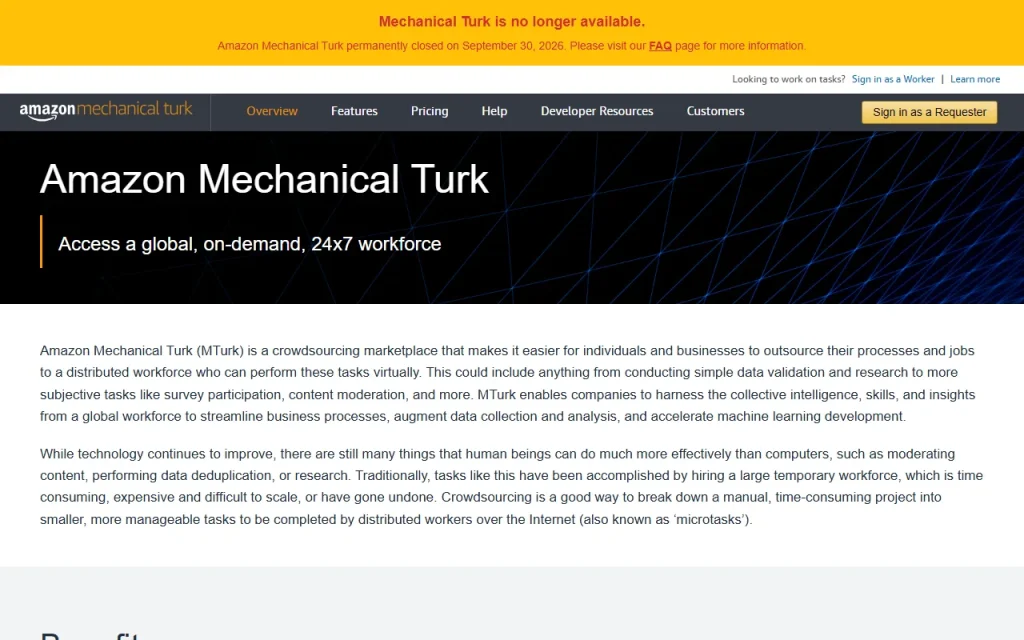
Amazon Mechanical Turk (MTurk), the crowdsourcing marketplace Amazon launched in 2005, permanently closed on 30 September 2026. Amazon’s own site now carries the notice “Mechanical Turk is no longer available”, and says the service permanently closed on that date.
What the announcement said
Amazon told users on 25 August 2026, in a notice on the Mechanical Turk website, that it would close the service entirely on 30 September after an assessment of its programmes, tools and services. That gave workers and requesters about five weeks to wrap up after a run of more than 20 years. Amazon has not given a more specific reason.
Dates that matter after closure
- Worker payments: workers are paid for completed and approved tasks on their existing payment schedules, according to reports of the closure FAQ.
- 30 October 2026: requesters can still approve submissions and award bonuses until this date.
- 28 January 2027: transaction history stays available until this date, so export what you need for tax or research records.
These dates come from news coverage of Amazon’s FAQ; confirm them on Amazon’s help page.
What MTurk was
Businesses and researchers posted small online tasks called HITs, human intelligence tasks, and workers around the world completed them for a payment per task. It was widely used for survey and experiment recruitment in academic research and for data labelling in machine learning.
Where the work is going
Analysts quoted in the coverage say workers had already been moving to other data-labelling businesses such as Scale AI and Mercor. Other options for people who do expert AI-training work include DataAnnotation and Handshake AI, and companies like Welocalize hire linguists for similar data work.
If you used it for research
Researchers who recruited participants through MTurk now need another panel provider. Check any replacement’s participant screening and data-quality controls before moving a study, since results can differ between panels.
What we could not verify
We could not read Amazon’s closure FAQ in full, so payment and export details are as reported by news outlets. The worker count of more than 500,000 comes from press coverage.